
Groundwork Memo
Groundwork
Organizing technology built by and for organizers.
Organizing groups in the U.S. have grown more numerous, received more philanthropic investment, and made some real gains for their constituents over the past twenty years.[1] The infrastructure around them has grown too: the consultants, the trainers, the technology vendors, and the accountability demands imposed by funders and regulators.[2]
And yet the balance of power in American political life has not shifted commensurately. There are more organizations, more funding, and more activity, yet a participation-power gap that remains stubbornly wide.
The technology is part of that story. Groups have spent twenty years paying increasing fees to vendors whose incentive is contract growth, not movement growth.
The dominant tools, now owned by private equity firms, have gotten more expensive, more oriented toward large institutional clients, and no better at the thing that actually matters: helping organizers capture their data, learn from it, and deliver the real changes their members seek.[4] The data has not gotten better. The practice has not gotten more sophisticated. The investors have done fine.
This is not only a technology failure, it is also a structural one.[3] When the infrastructure is owned by firms whose returns depend on user dependency, the incentive structure favors retention over the development of organizing practice.
Groundwork is built on a different premise: that the organizations doing this work should own the infrastructure, own the data, and directly influence the roadmap of the features that good organizing practice actually requires.
Modern tooling makes a production-quality custom build feasible in weeks, not years. We estimate infrastructure costs in the range of $50 to $200 per month, and because the platform is open source, organizations retain full ownership of their data and complete control over the features they use. That openness matters beyond any single organization. An open-source organizing platform is available to groups across the ideological spectrum, which means the infrastructure itself is democratically accessible rather than locked behind a vendor's pricing tier or political preferences.
In practice, Groundwork runs as a hosted platform where each member organization gets its own subdomain, admin credentials, and onboarding support. Depending on capacity and need, some organizations may also receive hands-on help from a forward-deployed engineer for configuration and data migration. Organizations do not need to manage servers or write code to use it, but because the codebase is open source, any group with the capacity to do so can fork it, modify it, or run it independently.
Every person in the organizing ecosystem has a rich, searchable record with fields that reflect organizing practice: school, school district, legislative district, team assignments, leadership level, recruitment history, and relational connections.
Groundwork tracks engagement as an activity history: how many events, how recently, how deep. The view below shows participation density per person in a format borrowed from GitHub's contribution graph. Darker means more recent and more frequent engagement.
Organizing is spatial. Teams are rooted in schools, neighborhoods, and districts. Groundwork surfaces this structure visually: an interactive map that shows every team, color-coded by strength and sized by leadership density. Zoom in to a school and see how many core leaders, how many active leaders, and whether the team is growing or stalling.
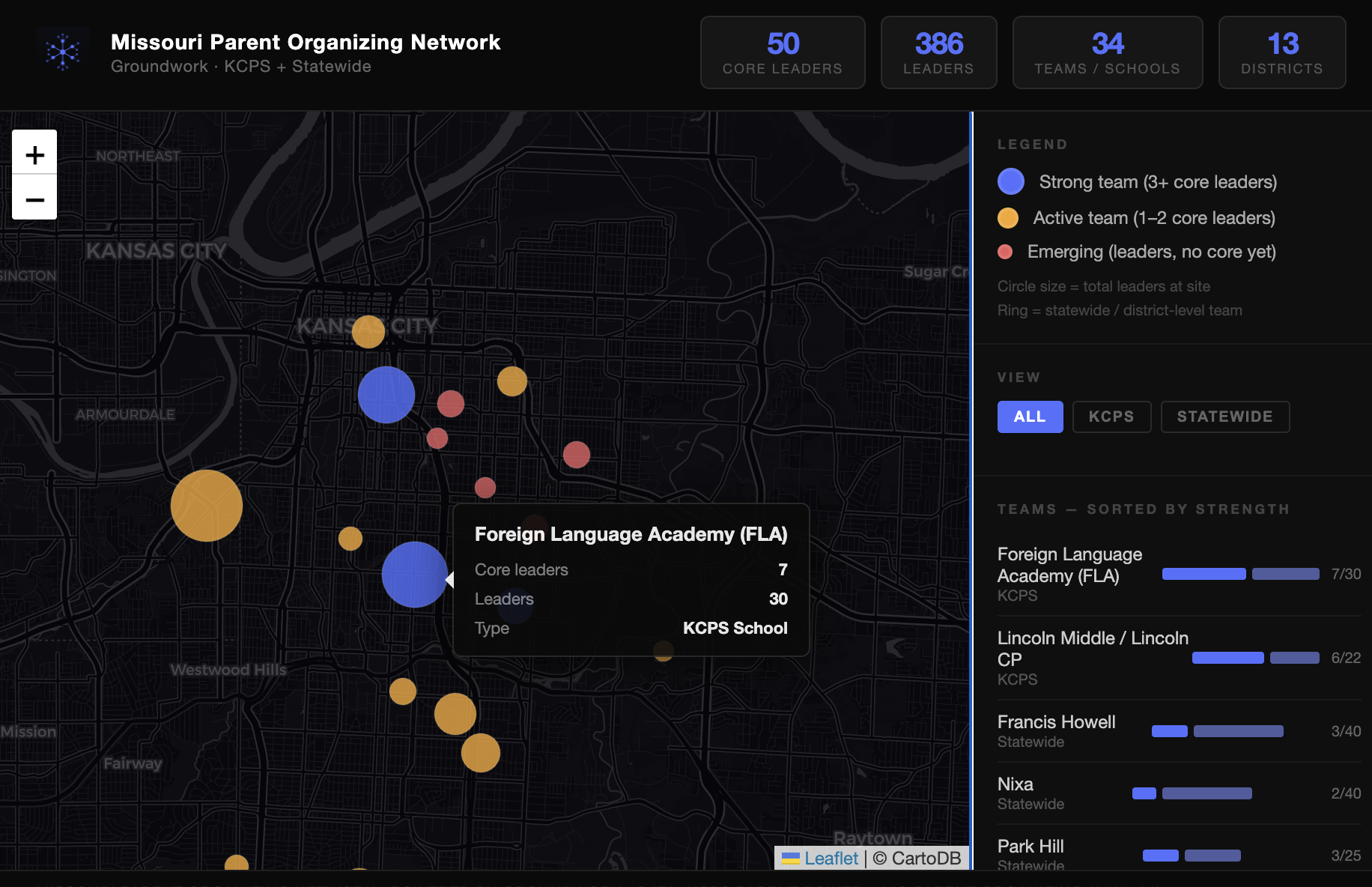
The map above shows a real organizational footprint: 50 core leaders, 386 leaders total, across 34 teams in 13 districts. The Foreign Language Academy popup shows the drill-down, with 7 core leaders, 30 total leaders, classified as a KCPS school team. This is the kind of spatial intelligence that organizing directors need for strategic deployment decisions, and it is the kind of knowledge that currently lives in someone's head or on a whiteboard rather than in a system the whole organization can see and act on.
Organizing has always had an implicit hierarchy of effectiveness. Every director knows who their strongest organizers are and which volunteer leaders are building real teams. But that knowledge is often anecdotal, subjective, and invisible to everyone else. Groundwork makes it legible.
Two leaderboards surface the metrics that matter. The Organizer Leaderboard ranks staff organizers by the outcomes their work produces: how many of their teams are strong (3+ core leaders), how many core leaders they've developed, and how large their active base is. The Volunteer Leaderboard ranks volunteer leaders by house meetings run, participants turned out, and conversion rate — the percentage of participants who take a next step.
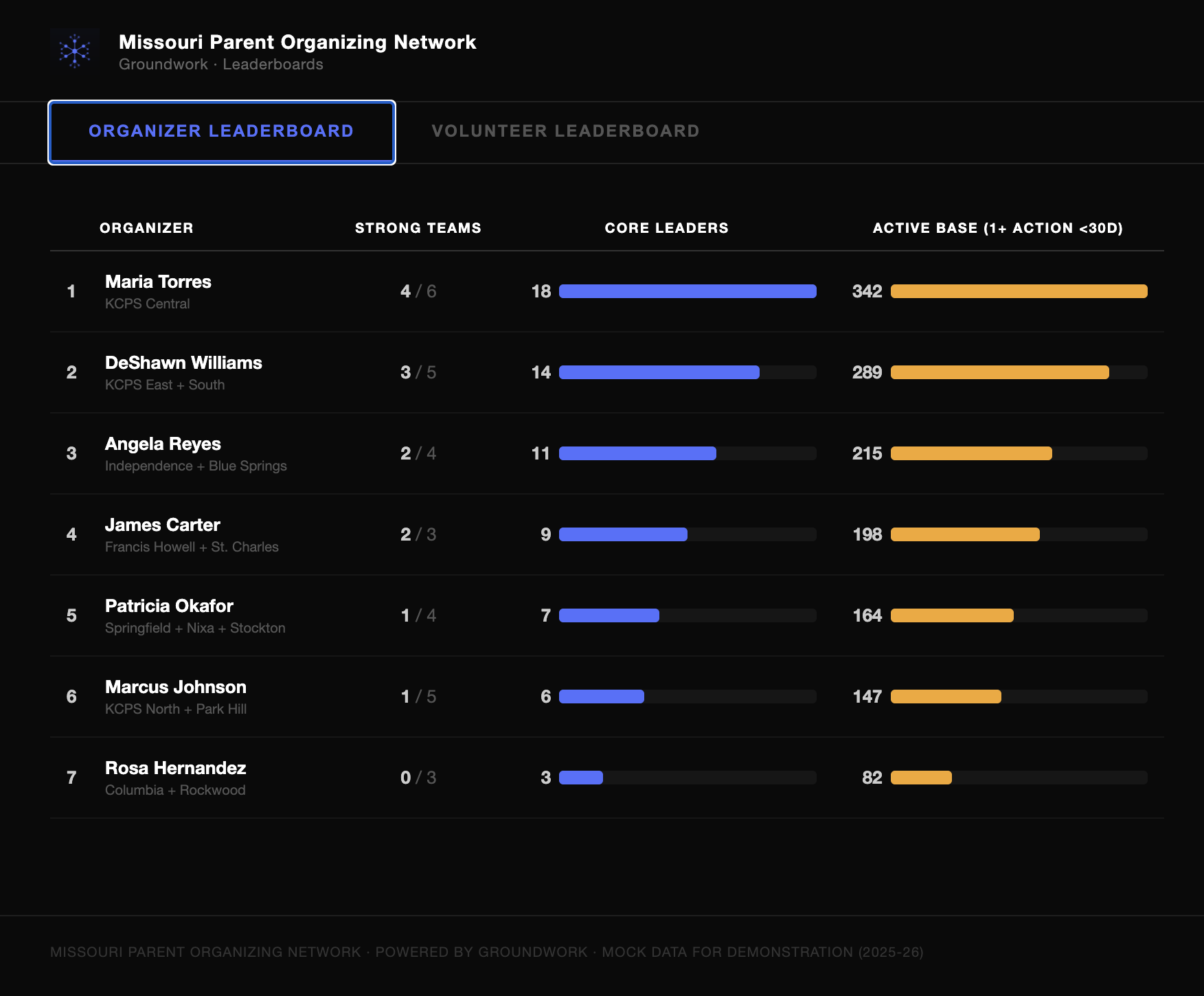
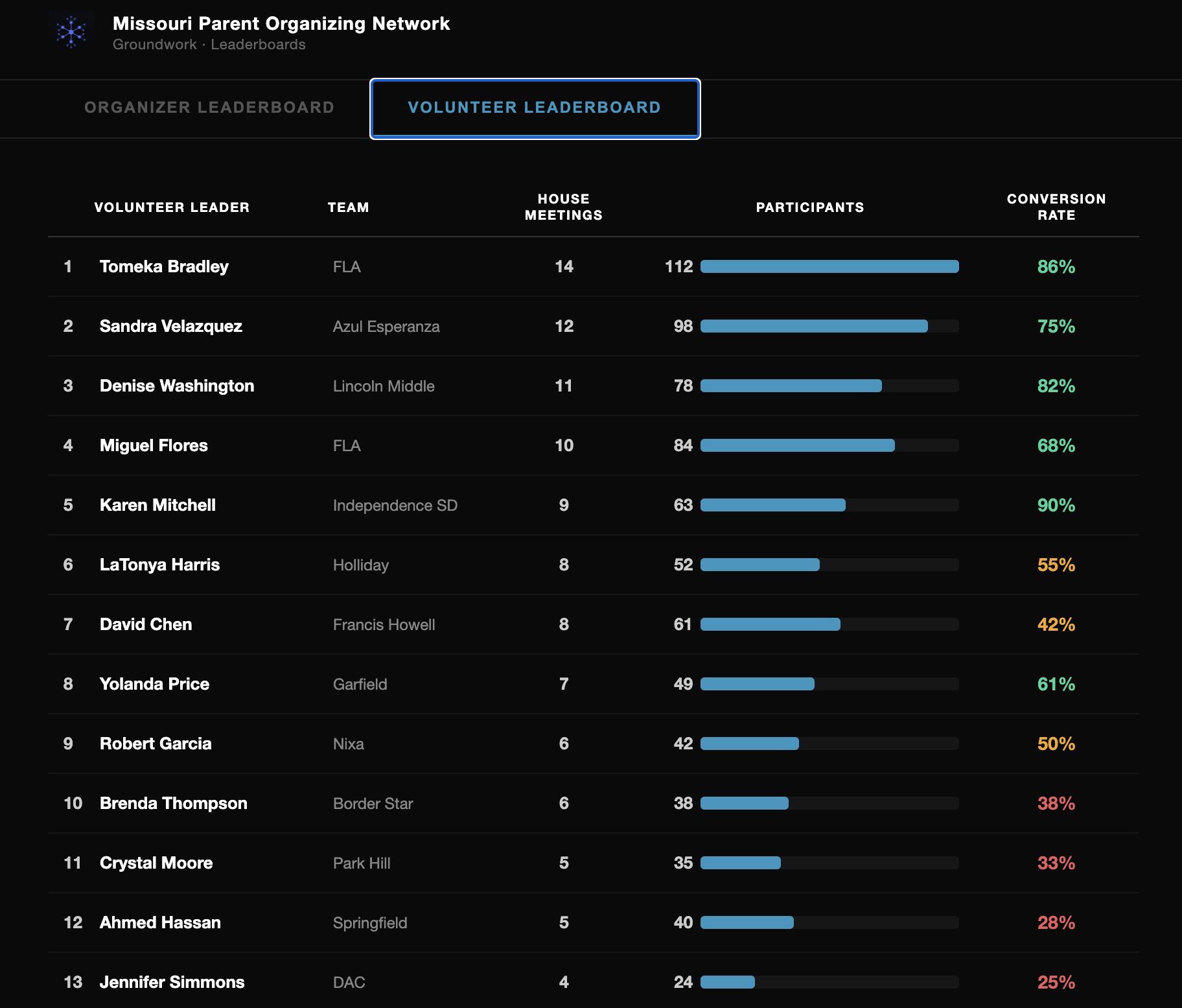
Maria Torres leads the organizer board: 4 of her 6 teams are strong, she has developed 18 core leaders, and 342 people in her active base have taken an action in the last 30 days. On the volunteer side, Tomeka Bradley leads with 14 house meetings and an 86% conversion rate. These aren't vanity metrics — they reflect the depth of relational work that drives durable power.
Groundwork allows organizers and leaders to log a note from their phone, between conversations, in the field. Tap the microphone, speak naturally, and Groundwork transcribes using the browser's built-in speech recognition with a server-side transcription model as a fallback for accuracy. AI extracts structured data from the transcript and proposes each field for one-tap confirmation.
"90 percent of organizing is follow-up." — Fred Ross, Axioms for Organizers
Every 1-on-1 note can (and should) include a structured commitment. Commitments surface in the organizer's follow-up queue with due dates. If someone committed to attend an event and did not show, Groundwork flags it automatically, on their contact record and in the organizer's queue. Over time, commitment history builds a real picture of reliability, depth of engagement, and readiness for leadership.
Each event gets a unique QR code, printable or displayed at the door. Attendees scan, see their name pre-filled if registered, and tap once to confirm. Walk-ins type their name and email; Groundwork creates a new contact record automatically, flagged for follow-up, with the event as their first activity on record.
For organizers managing the door, iPad roster mode shows large-text attendee names with a single tap to check in. It works offline and syncs when connection is restored.
The weekly reflection is where organizing learning lives. It is where someone notices that a team imploded because of a relationship gap, or that a leader is ready for more, or that they have been avoiding a hard conversation. That learning currently evaporates or sits in a Google Doc no one revisits.
Groundwork's weekly reflection arrives Friday afternoon as a push notification. It pre-populates the week's activity automatically: events run, 1-on-1s logged, commitments followed up, new contacts added. The organizer fills in the human parts. All fields are voice-enabled.
On submission, Groundwork auto-formats the inputs into a readable weekly memo and pushes it to the supervisor or coach. They leave a brief comment; the organizer receives it as a notification. A lightweight coaching loop that currently requires significant manual discipline to maintain.
| EveryAction / NGP VAN | Groundwork | |
|---|---|---|
| Monthly cost | $500–2,000+ | ~$50–200 (est.) |
| Data ownership | Vendor (PE-owned) | 100% yours |
| Voice 1-on-1 notes | No | Yes, with AI extraction |
| Commitment tracking | No | Yes, with auto-flag |
| Weekly reflection | No | Yes, with coaching loop |
| QR event check-in | Limited | Yes, self-check and iPad roster |
| Engagement activity view | No | Yes, contribution-graph style |
| Feature roadmap driver | Revenue | Value to users |
| Onboarding support | Variable | Forward-deployed engineer |
| Cross-org learning | No | Optional, opt-in data agreement |
Future builds will include email integrations and payment processing for member dues and donations. These are capabilities that existing tools like EveryAction and NGP VAN are optimized for today. But our focus at launch is on the organizing practice layer: the features that are missing now and that no one else is building. Voice notes, commitment tracking, geospatial mapping, leaderboards, and the coaching loop. That is where the gap is widest and where the leverage is greatest.
Groundwork operates as a platform. Organizations receive a subdomain, admin credentials, and onboarding support from a forward-deployed engineer who helps configure fields, map existing data, and train staff. No organization needs to manage servers or write code.
Organizations that opt into the shared data agreement gain access to participation benchmarks, retention patterns, and leadership density comparisons across the field, something no individual organization can generate alone. Participation is entirely voluntary, governed by a signed data use agreement, and involves only deidentified data shared for independent academic research. It is separate from the platform and has no effect on any organization's access to Groundwork.
Organizing databases contain sensitive information about real people. Unlike commercial consumer CRMs, which are built around online behavioral data and digital marketing profiles, an organizing platform holds records about offline relationships: who showed up to a house meeting, who made a commitment to their neighbor, who is developing as a leader. That difference shapes everything about how Groundwork handles privacy and security.
At the contact level, Groundwork is designed so that individuals can participate with minimal traceable information, following the same logic that Signal uses for secure communication. A contact record requires only a display name and a preferred contact method, which can be a Signal username, a phone number, an email, or a WhatsApp handle. Everything beyond that, including address, demographic information, and leadership assessments, is opt-in at the level of the individual record. This means organizers can build a relational database without requiring the people they work with to surrender personal information as a condition of participation.
Groundwork is designed so that organizers can trust it with the most sensitive information they hold about the people with whom they work.
Help shape Groundwork. What do you think?
[1] Han, Hahrie, Elizabeth McKenna, and Michelle Oyakawa. 2021. Prisms of the People: Power and Organizing in Twenty-First-Century America. Chicago: University of Chicago Press. https://press.uchicago.edu/ucp/books/book/chicago/P/bo68659118.html.
[2] Horvath, Aaron. 2023. "Organizational Supererogation and the Transformation of Nonprofit Accountability." American Journal of Sociology 128 (4): 1031–76. https://doi.org/10.1086/723799.
[3] INCITE! Women of Color Against Violence, eds. 2017. The Revolution Will Not Be Funded: Beyond the Non-Profit Industrial Complex. Durham, NC: Duke University Press. https://www.dukeupress.edu/the-revolution-will-not-be-funded.
[4] Kalchick, Carter. 2023. "Surveying the Landscape of Data Integration for State and Local Organizing Groups." Democracy and Power Innovation Fund. https://www.dpifund.org/research.
[5] Lacy, Akela. 2023. "As 2024 Looms, Democrats' Campaign Tech Crumbles Under Private Equity Squeeze." The Intercept, October 5. https://theintercept.com/2023/10/05/democrats-campaign-tech-layoffs-2024-bonterra-ngp-van-actionkit/.
[6] Sifry, Micah L. 2023. "Living with VANxiety: The Present and Future of Progressive Movement Tech." April 29. https://micahsifry.com/project/living-with-vanxiety-the-present-and-future-of-progressive-movement-tech/.
[7] Goldmacher, Shane. 2025. "Inside the Democratic Disaster That Didn't Happen in November." New York Times, March 1. https://www.nytimes.com/2025/03/01/us/politics/democrats-voter-data.html.